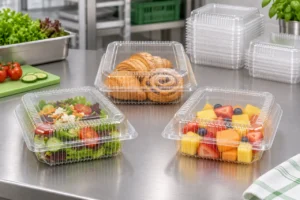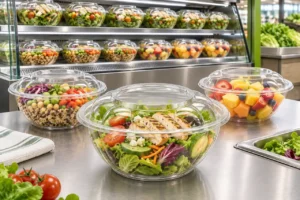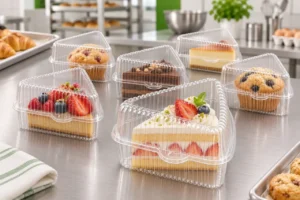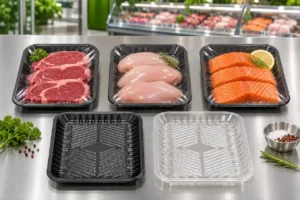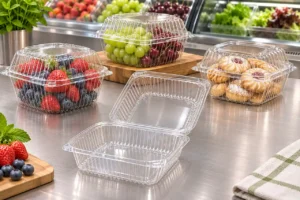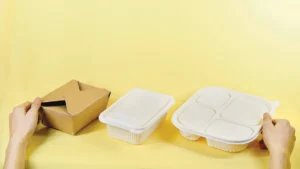
When buyers compare clamshell packaging, the outer dimensions are only the beginning. A container can look correct on a specification sheet and still create problems on the packing line if the usable interior height, hinge movement, closure pressure or carton quantity does not match the food and the process.
I find it more useful to treat the purchase as a short decision path: define the food, confirm how the package will be handled, then compare structures and logistics. This approach keeps the conversation practical and gives purchasing teams a clearer basis for requesting samples.
Four Decisions That Define the Right Clamshell Packaging Structure
1. Start with the food profile, not the nominal capacity
Measure the product at its widest and tallest points, including toppings or irregular edges. A pastry with a fragile crown needs clearance above the product, while berries or cut fruit may need a footprint that limits movement. For foods with surface moisture, buyers should also discuss ventilation and drainage requirements rather than assuming that every clear hinged container performs the same way.
2. Match the footprint to display and handling
A compact square package can use retail shelf space efficiently, but the best footprint also depends on the packing table, label size and how customers hold the product. For supermarket and foodservice programs, it helps to evaluate the container in the actual display case and shipping carton before approving a model.
3. Evaluate the hinge and closure as working parts
The hinge should open far enough for filling without pulling the base out of position. The closure should engage consistently without excessive force and remain dependable after normal handling. If the pack will be opened and closed more than once, sample testing should include repeated use, cold storage and stacking.
4. Check carton quantities before final approval
Unit price is not the complete purchasing cost. Case quantity, carton dimensions, nesting and pallet planning affect warehouse space and freight efficiency. A slightly different model may be the better commercial choice when it simplifies inventory and recurring orders.
Three Common Buying Mistakes—and the Better Question to Ask
Mistake: choosing by capacity alone
Ask instead: What are the usable internal dimensions after the lid ribs, corners and closure area are considered? This is especially important for tall pastries, sandwiches and products with a fixed presentation shape.
Mistake: assuming a clear lid guarantees good presentation
Ask instead: Will the product remain centered, visible and protected through filling, stacking and transport? Clarity works best when the base supports the product and the lid provides enough headroom.
Mistake: approving a sample without testing the process
Ask instead: Can operators fill, close, label and case-pack the container at the expected speed? A short packing trial often reveals issues that cannot be seen from dimensions alone.


A Practical Model Map for Early Comparison
These models illustrate how the same general package style can serve very different portions and products:
- HC5 clear PET square hinged clamshell — 120 × 125 × 72 mm, suitable for compact products that need useful vertical clearance.
- TT072 clear PET square hinged clamshell — 150 × 155 × 60 mm, a broader footprint for small bakery, produce or snack applications.
- TT093 clear PET square hinged clamshell — 287 × 195 × 55 mm, a longer format for larger or arranged products.
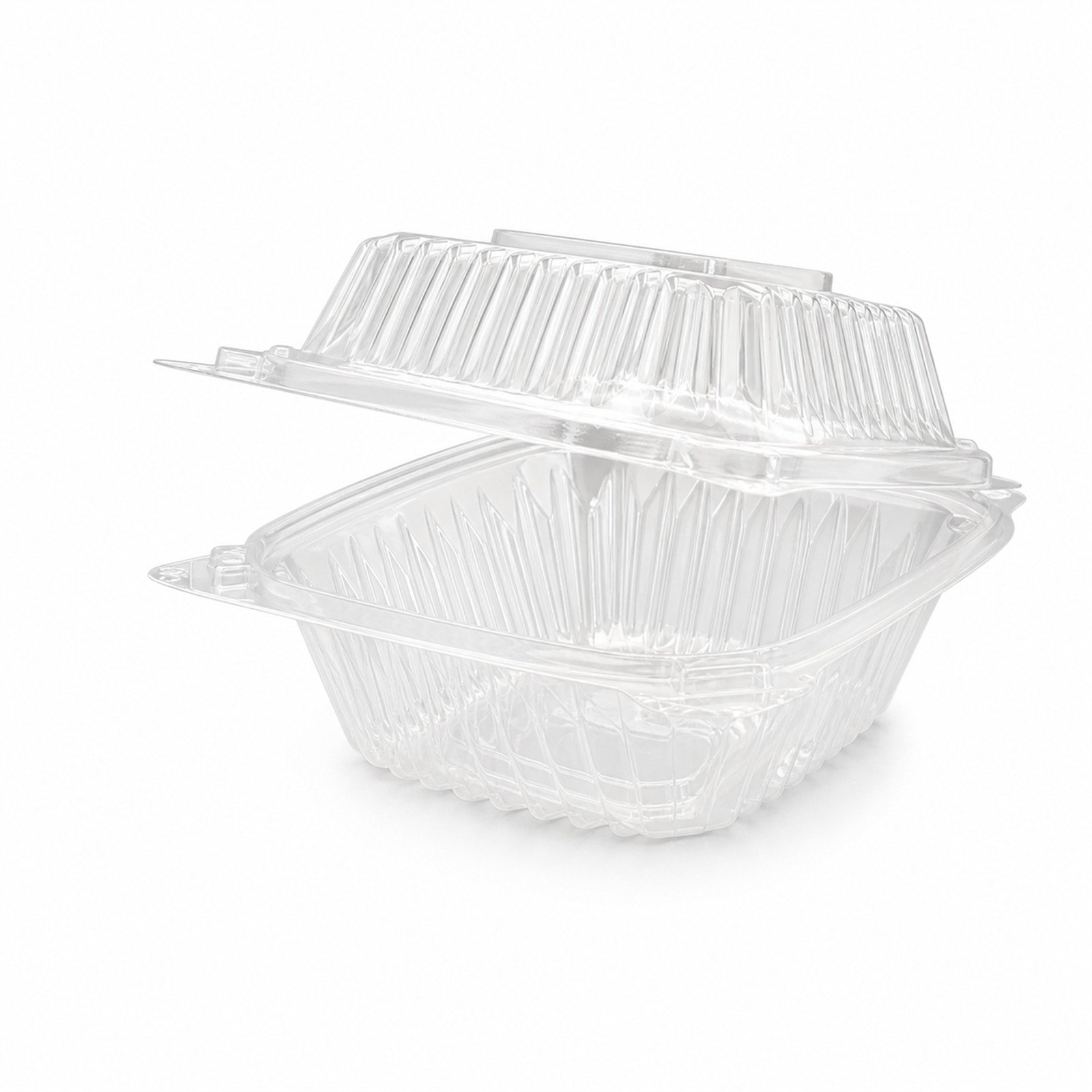
- YT301-PF6 clear PET square hinged clamshell — 210 × 210 × 75 mm, a medium square option for prepared foods, bakery and fresh produce programs.
- YT301-PF10 clear PET square hinged clamshell — 273 × 213 × 90 mm, offering greater footprint and height for larger products.
These are starting points rather than universal matches. Food density, temperature, ventilation, label placement and distribution conditions should all be checked with physical samples.
How I Would Narrow the Shortlist for Different Products
Compact bakery items or a single food portion
Begin with HC5 or TT072, then compare internal headroom and the way the product sits in the base. If appearance depends on a tall top or delicate decoration, lid clearance deserves more attention than nominal volume.
Arranged bakery, produce or prepared-food selections
TT093 or YT301-PF6 can provide more presentation area. Test label placement, shelf footprint and whether the package can be stacked without transferring pressure to the food.
Larger or taller products
YT301-PF10 is a useful candidate when additional depth and footprint are needed. Confirm carton quantity and storage space early, because larger containers can change the economics of recurring supply.
What to Send a Supplier for a Faster Recommendation
A concise request normally produces a better shortlist than a general inquiry. Include:
- food type, dimensions and target fill weight;
- required temperature range and storage time;
- whether ventilation, absorbent pads or special compartments are needed;
- label dimensions and preferred placement;
- expected monthly quantity and delivery market;
- photos of the product and, when possible, the packing and display process.
Buyers with unusual dimensions or closure requirements can review our custom plastic food packaging process. For retail program planning, the supermarket food packaging application shows how clear containers fit broader fresh-food and prepared-food ranges.
Final Purchasing Note
The most reliable clamshell packaging choice is the one that works for the food, the operator, the display and the carton—not simply the model with the nearest capacity. A structured comparison and a small sample trial can prevent costly changes after an order is placed. If you would like help comparing existing sizes or evaluating a custom format, contact KD Food Pack with your product dimensions and packing requirements.